Niger’s military cracks from the inside: desertions, empty depots and the night Russian guns turned on Nigerien soldiers
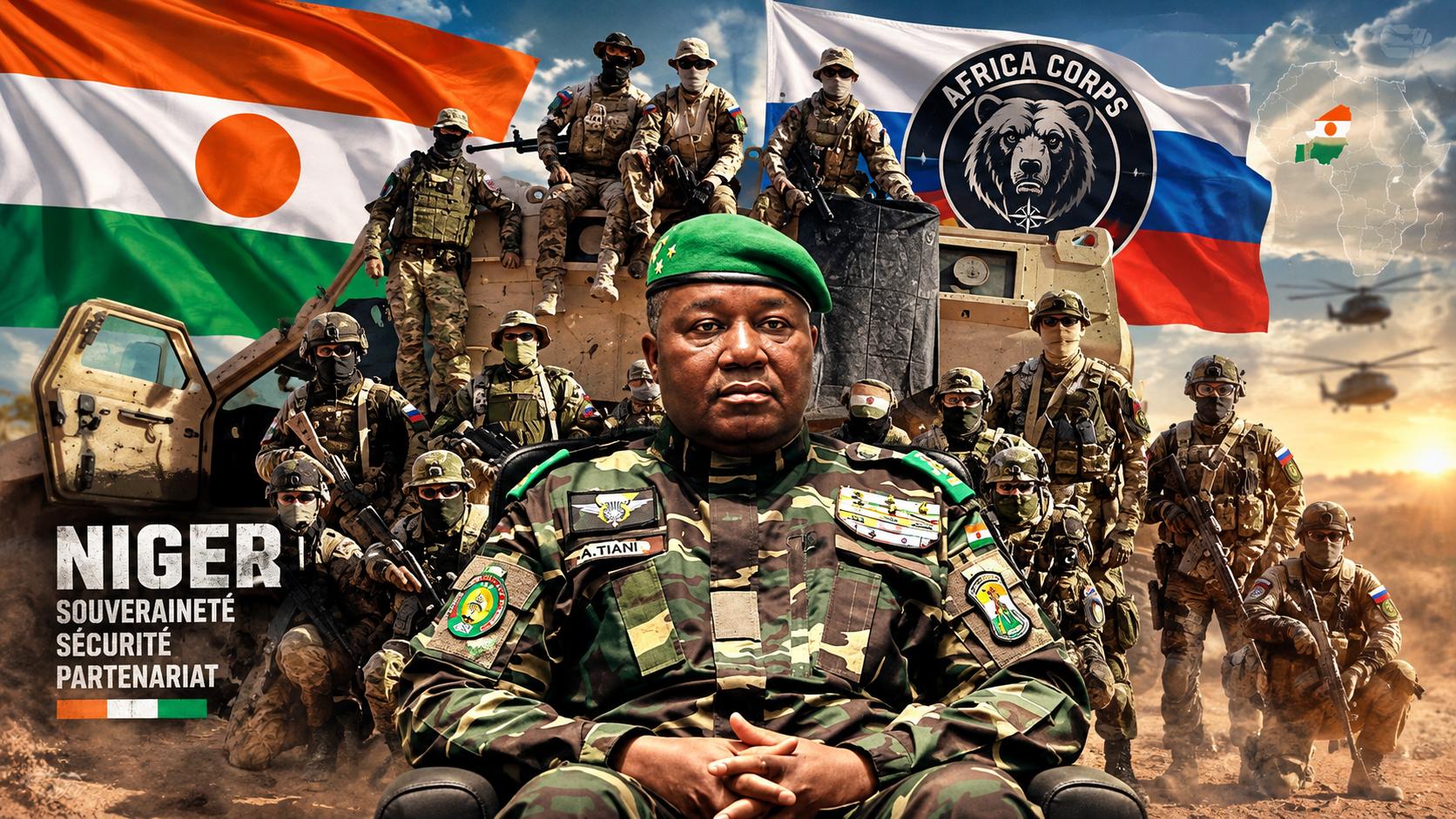
Eighteen months after the coup of 26 July 2023, the sovereignist showcase erected by Niger’s military leadership is visibly coming apart. Behind the parade-ground imagery and the defiant speeches of the Conseil national pour la sauvegarde de la patrie (CNSP), the situation on the ground tells an entirely different story. Niger’s armed forces are not merely buckling under suffocating security pressure along the borders — they are dissolving from within, and the wave of defections now sweeping the ranks has become the clearest proof that General Abdourahamane Tiani has lost the confidence of a large share of his own troops.
A patriotic façade that no longer holds
The narrative of a united, unshakeable military machine, pushed relentlessly by the junta’s communication apparatus, collides with a far grimmer operational reality. Garrisons are stretched thin, isolated units are left to fend for themselves, and the men who wear the uniform increasingly feel they are being asked to die for a cause they no longer recognise. What began as scattered acts of insubordination has hardened into something systemic: a steady, organised drain of personnel out of the institution.
Battlefield reality: an army short of everything
To understand the desertions, it helps to look at what soldiers actually have in their hands when they deploy. The answer, according to the accounts coming out of the front lines, is painfully little.
Spare parts, fuel and ammunition: the basics are missing
Despite the martial rhetoric emanating from Niamey, supply chains have not followed. Troops sent to the hotspots of Tillabéri and Diffa operate with armoured vehicle fleets grounded for lack of spare parts, rationed fuel and reserve ammunition that evaporates within hours of a firefight. Facing mobile armed groups equipped with light drones and modern assault rifles, Nigerien soldiers often lack even basic personal protective equipment or secure communications gear.
Late risk bonuses and abandoned wounded
Material hardship is compounded by administrative neglect. Hazard pay arrives late, sometimes not at all, and medical care for soldiers wounded at the front is patchy at best. The contrast between the comforts enjoyed by senior figures installed in Niamey and the misery endured by the rank and file in the field has bred a bitter, enduring resentment that no patriotic slogan can dispel.
The exodus from the barracks
Against that backdrop, the flow of soldiers abandoning their posts has accelerated dramatically. Disillusioned and left without support in remote outposts, dozens have simply walked away. What alarms the authorities most is that these men are not quietly returning to civilian life — they are carrying their tactical expertise, and in some cases their weapons, straight into the ranks of armed opposition movements and jihadist organisations.
Joining the FPL: tactical know-how for the rebellion
A notable number of seasoned combatants have enlisted with the Front Patriotique pour la Libération (FPL), the rebel movement headed by Mahmoud Sadi, which calls for a return to constitutional order and the release of deposed president Mohamed Bazoum. Their arrival injects the group with a level of military competence that transforms a political rebellion into a structured paramilitary force capable of targeting strategic infrastructure, notably the oil pipeline connecting Niger to Benin.
Crossing a red line into JNIM
Even more troubling for regional stability, some soldiers go further and join Jama’at Nusrat al-Islam wal-Muslimin (JNIM), al-Qaeda’s Sahel branch. Driven by despair, a sense of abandonment or plain material incentives, these former regular-army personnel hand the jihadists intimate knowledge of the local security architecture, leaving military bases in the west of the country more exposed than ever before.
The August night when Africa Corps fired on Nigerien troops
Mistrust between the rank and file and the top of the chain of command reached a point of no return late in the summer. During the night of 28 to 29 August, an incident of extraordinary gravity exposed the yawning rift between the troops and the general staff: an attempted uprising that was put down in blood, with the regime’s Russian allies at the centre of it.
Confronted with mounting unrest across several army units, the junta called in Russian Africa Corps personnel to secure key installations and crush any appetite for mutiny. In the course of those night-time clashes, Russian mercenaries opened fire directly on Nigerien service members. The episode, in which several national soldiers died from foreign bullets on their own soil, sent shockwaves and a wave of fury through the barracks.
For the non-commissioned officers, watching a self-declared sovereignist regime order foreign mercenaries to shoot at its own troops amounts to the ultimate betrayal. That night, General Tiani’s moral standing with his enlisted men collapsed beyond repair.
A junta cornered by the institution that put it in power
Far from the image of an indivisible military power, Niger’s junta now looks weakened by the very base that lifted it to power. By failing to meet either the logistical needs of its soldiers or the population’s longing for stability, General Tiani finds himself increasingly isolated. Mass desertion and the flight of trained personnel towards rebellion or jihadism show that the army refuses to serve as cannon fodder for a regime whose objectives it no longer shares. If the fracture keeps widening at its current pace, the gravest threat to the CNSP will not come from beyond the borders — it will emerge from inside its own barracks.