Niger’s kirtachi attack: secret defense document exposes jnim’s massive haul
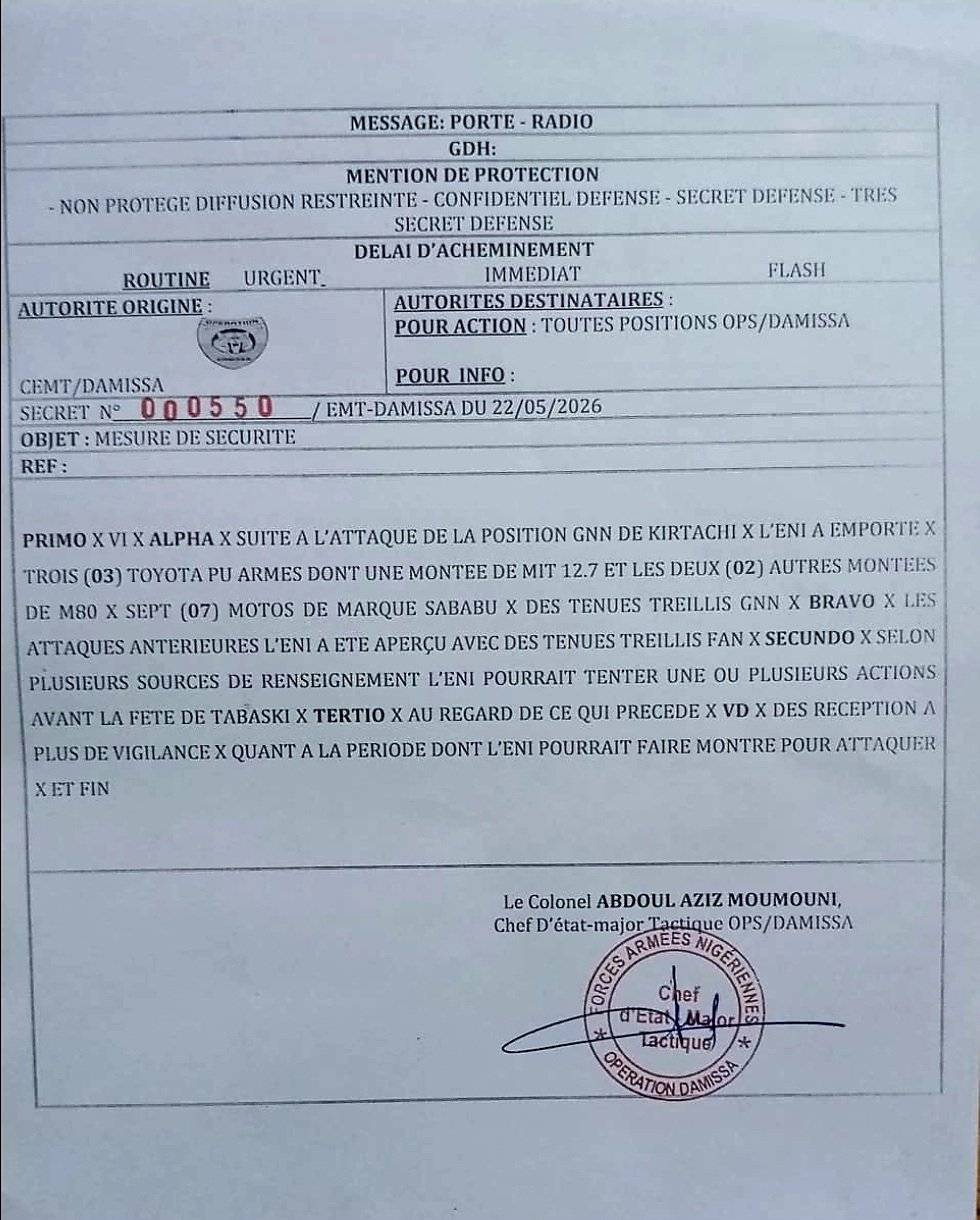
Following a brutal assault on the Garde Nationale du Niger (GNN) in Kirtachi, located within the Tillabéri region, an internal radio dispatch, dated May 22, 2026, has cast light on the true extent of losses suffered by the Forces de défense et de sécurité (FDS). This official military document, marked « secret défense », corroborates the significant cache of weaponry and critical strategic gear seized by terrorists from the Groupe de soutien à l’islam et aux musulmans (JNIM). Amidst a particularly heavy human toll and the looming threat of infiltrations as the Tabaski festival approaches, Nigerien forces confront a formidable security challenge.
Behind the revealing leak
In the ongoing asymmetric conflict impacting Niger, official reports frequently offer incomplete assessments. However, an internal radio message, intercepted and examined this Friday, May 22, 2026, shatters customary regulatory silence. Originating from the highest military echelons, this classified record meticulously outlines the severe setback endured by the Niger National Guard detachment in Kirtachi, a strategic location within the volatile "three borders" area.
The disclosure of this technical memo provides a precise understanding of the assault’s logistical repercussions. Far removed from typical social media conjectures, this staff document presents a stringent inventory that deeply concerns the national operation’s command, highlighting critical aspects of governance Africa.
Arsenal and logistics: an alarming inventory
The profound impact of this classified dispatch stems from the extensive list of military hardware seized by the JNIM. The attackers executed a comprehensive logistical plunder, stripping the detachment of its vital mobility and firepower.
According to the internal radio communication, the adversaries successfully appropriated three armed Toyota pick-up trucks, all prepared for combat. One of these vehicles was mounted with a formidable 12.7 mm heavy machine gun, an weapon renowned for its high rate of fire against ground forces, while the other two were fitted with M80-type machine guns. The assailants also acquired seven Sababu brand motorcycles, lightweight and robust vehicles ideally suited for rapid assaults across the Sahelian terrain.
Even more alarming for the future security of operations in Niger, the document reports the theft of numerous GNN camouflage uniforms. This appropriation of official attire poses an immediate risk of infiltration attacks, enabling terrorists to impersonate Nigerien soldiers and bypass security checkpoints.
A rising human toll
This material catastrophe compounds a human tragedy, the official count of which remains deeply distressing. The fierce engagements in Kirtachi claimed the lives of 12 FDS personnel, who made the ultimate sacrifice while attempting to repel the incursion.
Beyond these fatalities, the secret document notes the disappearance of four additional Nigerien soldiers, officially classified as abducted. The fate of these military hostages remains unknown, as the JNIM frequently leverages prisoners of war as bargaining chips or propaganda tools via its media channels. This dual crisis underscores the intense pressure exerted by non-state armed groups across the Tillabéri region, a critical aspect of African politics and stability.
Maximum alert ahead of Tabaski
In response to the gravity of the situation and the recovery of such strategic equipment, the military command reacted swiftly. The confidential memo from May 22, 2026, issues an urgent directive to all operational positions nationwide, demanding heightened vigilance.
Military analysts express concern that the JNIM might promptly utilize this captured arsenal to launch further significant operations. The timing is particularly critical as the Tabaski festival draws near. This period of profound religious observance and extensive population movement presents a vulnerability that terrorist groups have historically exploited to inflict widespread psychological impact, affecting society Africa at large.
The Kirtachi attack and the revelations contained within this « secret défense » document starkly underscore the intricate and severe nature of Niger’s security crisis. By seizing armed pick-up trucks, heavy machine guns, and official uniforms, the JNIM has temporarily augmented its capacity for harm and its operational mobility within the crucial three borders region. For the Nigerien army, the challenge is now twofold: to safeguard communities during the upcoming Tabaski celebrations and to urgently adapt on-the-ground tactics to counter an adversary now equipped with its own previously-owned armaments.