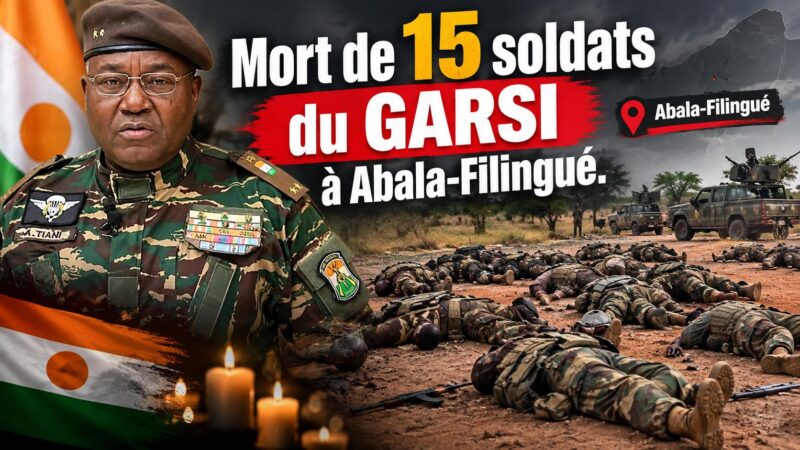
Niger: 19 gendarmes and 38 soldiers killed in one day in Tillabéri and Tahoua
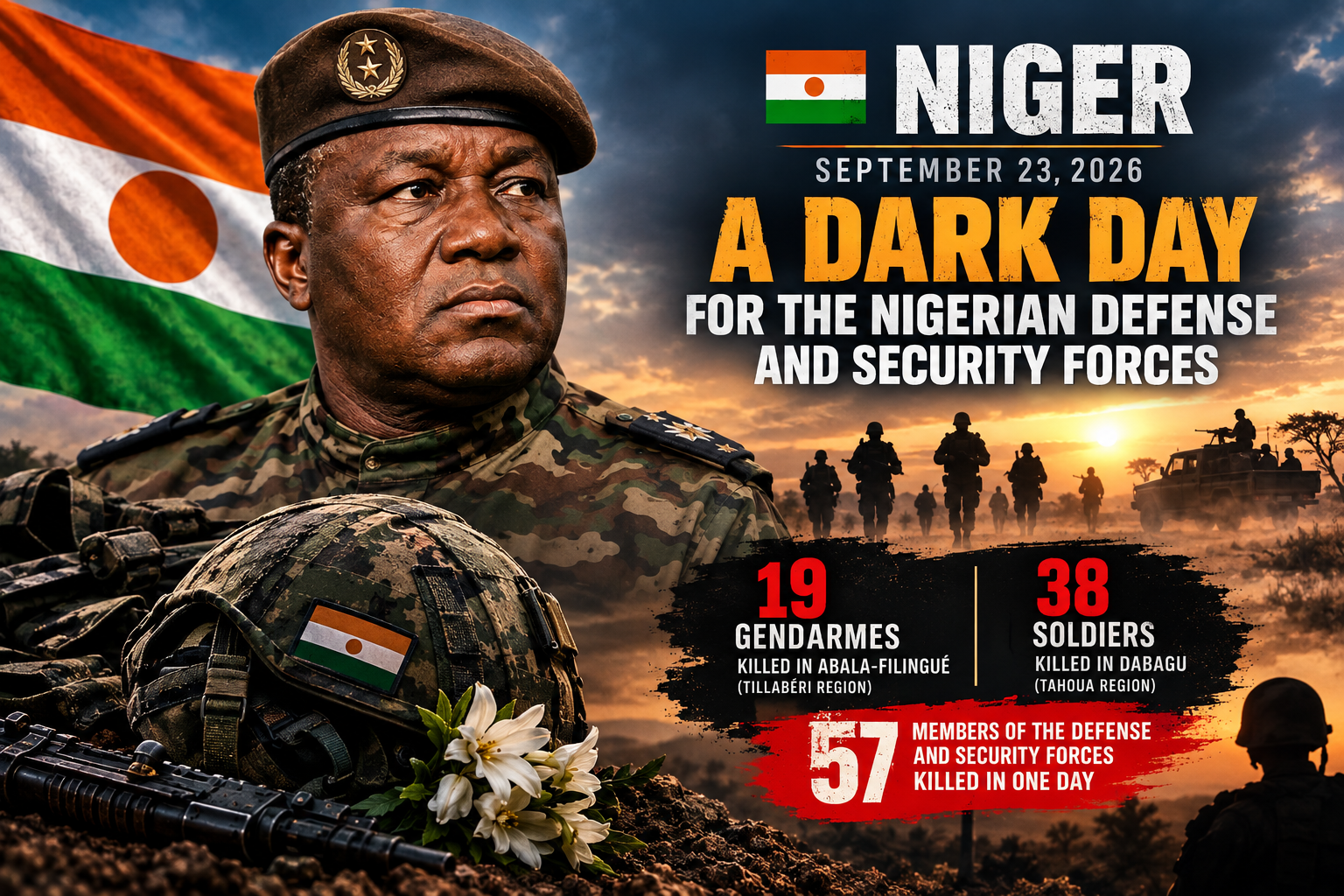
September 23, 2026 now ranks among the darkest dates in Niger’s recent security record. Within the space of a few hours, the country’s defence and security forces absorbed heavy losses in two separate engagements, exposing once more the pressure that armed groups continue to exert along several fronts.
The provisional toll: 19 gendarmes in Tillabéri, 38 soldiers in Tahoua
In the Abala-Filingué area of the Tillabéri region, 19 gendarmes were killed. On the same day, at least 38 soldiers of the Nigerien Armed Forces lost their lives during an assault on a military position at Dabagu, in the Konni department of the Tahoua region. Several troops involved in that second engagement are also unaccounted for. These figures remain provisional and have yet to be formally confirmed by the Nigerien authorities.
Taken together, the two attacks bring the provisional toll to 57 members of the defence and security forces killed in a single day. The scale of that loss revives a question that has become recurrent: is the security architecture built under the administration of General Abdourahamane Tiani genuinely capable of shielding its own personnel from mobile, organised and heavily armed groups?
Abala: an intercepted cattle convoy that turned into an ambush
In the Abala sector, the Nigerien Ministry of Defence confirmed that defence and security personnel engaged in an operation to intercept a convoy of stolen cattle were confronted on the morning of September 23 by a large column of armed men travelling on motorcycles. The ministry acknowledged human and material losses within Nigerien ranks, without publishing any official count.
The gap between public statements and the figures on the ground
The distance between the ministry’s account and the numbers that have emerged from the affected areas deserves close scrutiny. How many soldiers and gendarmes actually died? How many were wounded, and how many are still missing? Which equipment was lost? And above all, why do units deployed in such exposed positions continue to sustain losses of this magnitude despite repeated declarations about strengthening Niger’s military capacity?
The tactical advantage held by motorcycle-borne columns
The problem cannot be reduced to the courage of the troops. Niger’s defence and security forces are facing adversaries able to move rapidly on motorcycles, concentrate their fighters against isolated positions and withdraw before reinforcements arrive. Under such conditions, several factors become decisive:
- Intelligence gathering and timely warning
- Mobility and the capacity to reinforce threatened positions
- Aerial surveillance of vast, sparsely monitored areas
- Reliable communications between forward units and command
- The equipment available to the most advanced detachments
Three years of the CNSP: what the September 23 losses actually measure
The events of September 23 also raise a broader political and strategic question: are the resources announced over several years to reinforce national security genuinely delivering the expected results in the field? Since the CNSP assumed power in July 2023, security has been presented as one of the regime’s foremost priorities. The losses recorded on September 23 therefore interrogate the effectiveness of that strategy directly.
Niger maintains that it has bolstered its military capabilities and intends to progressively regain control of its territory. Yet repeated attacks against the defence and security forces demonstrate that entire areas remain extremely vulnerable. The Tillabéri region, in particular, continues to register intense activity by armed groups.
Fifty-seven families, and questions still without answers
The balance sheet for that single day is therefore heavy: 57 members of the Nigerien forces killed according to provisional counts, with wounded personnel and soldiers whose fate has not yet been definitively established. The total could still rise. At this stage, the Nigerien Ministry of Defence has not publicly confirmed the overall figure.
Beyond communiqués and statistics, it is 57 households that may have been struck by bereavement.
What September 23 demands of those in power
The date is not simply another entry in the calendar of attacks recorded in Niger. It is a signal that compels reflection on the effectiveness of the intelligence apparatus, the protection of forward positions, the equipment of deployed units and the overall strategy for confronting armed groups.
It also forces attention onto the political responsibility of the current leadership. The Tiani administration cannot confine itself to highlighting the military means mobilised and the operations announced; it must also account for the results obtained on the ground, particularly when dozens of defence and security personnel are killed in a single day.
For when dozens of soldiers and gendarmes fall within twenty-four hours, the question is no longer merely how many adversaries were neutralised. It is also why so many defenders of the national territory continue to pay such a price, and why, more than three years after the CNSP came to power, certain areas remain as exposed as they have ever been.