Deadly ambush shakes Mali’s north: what happened at Tabrichat?
On the morning of July 18, a military convoy comprising Malian Armed Forces (FAMa) troops and Russian mercenaries from the Africa Corps was ambushed near the remote village of Tabrichat, in northern Mali. The attack, described by witnesses as one of the most violent in over a decade, left at least 50 soldiers dead and dozens missing or captured. The tragedy unfolded as the convoy traveled from the strategic camp of Anéfis toward Gao, a major northern hub, exposing critical weaknesses in coordination and battlefield response.
How the ambush unfolded: a calculated trap
The convoy, stretching over several kilometers across rugged terrain, moved in two distinct sections: Russian mercenaries at the front and Malian troops at the rear. As the column neared Tabrichat—strategically located between Gao, Bourem, and Kidal—the ground forces of the JNIM and FLA coalition launched a coordinated assault. The attack focused almost entirely on the Malian rear section, leaving the soldiers exposed under heavy fire with no immediate support.
The terrain, marked by wadis and rocky outcrops, provided ideal cover for the attackers, who used precision strikes to isolate and overwhelm the Malian units. Survivors later recounted how communication broke down almost immediately, with no reinforcements or evacuation possible for those trapped under fire.
A grim human toll and documented war crimes
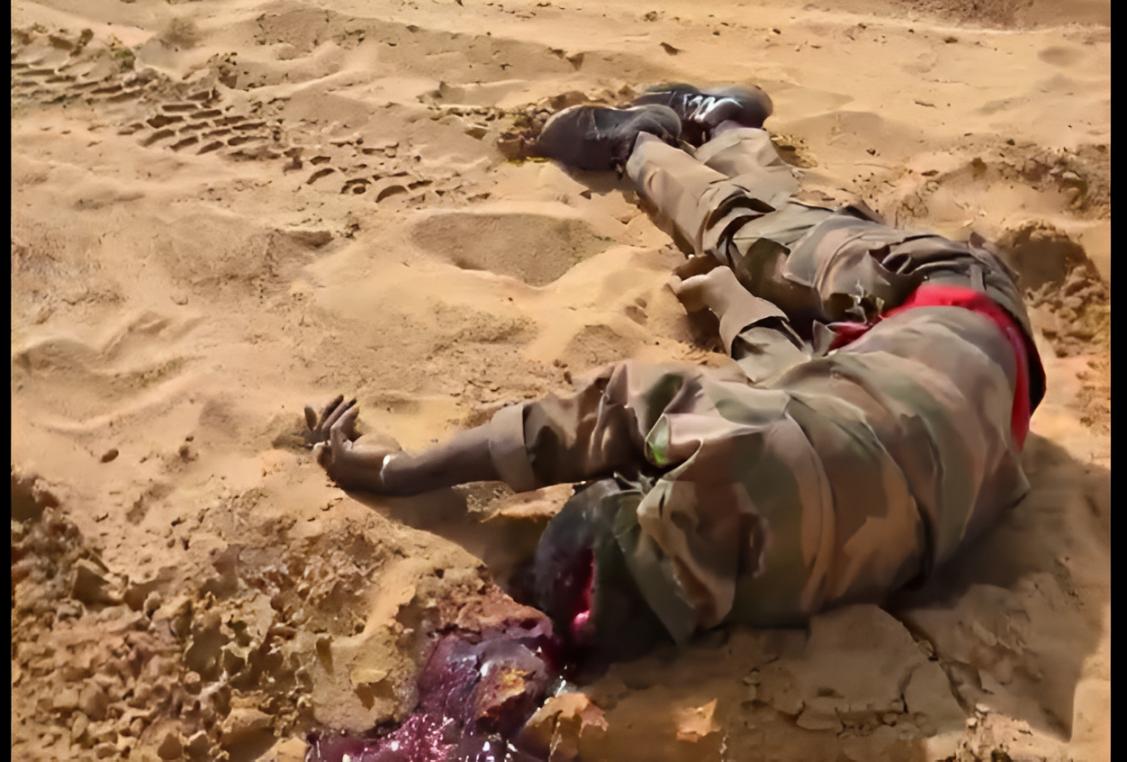
The immediate aftermath revealed a devastating toll: over 50 Malian soldiers killed and more than 30 unaccounted for. Among the most alarming revelations were reports of summary executions. Despite being disarmed, several captured FAMa soldiers were shot at close range by insurgents. Graphic footage of the killings, later circulated online, sparked widespread outrage and deepened national grief.
What added to the shock was the initial dissemination of some of these images through channels linked to the Africa Corps. The incident fueled public skepticism about the role and reliability of foreign military support in Mali’s counterterrorism efforts.
Leadership on display: the rise of Hamza Ag Gali
Analysis of post-attack footage and intelligence reports confirmed the presence of Hamza Ag Gali, son of Iyad Ag Gali—the historical leader of the JNIM and founder of Ansar Dine. His involvement signals not only a generational shift in command but also a high-level strategic planning within the insurgent alliance. The coordination between the JNIM and the FLA factions, seen during this ambush, demonstrates a resurgent operational capability—one that appears to have outmaneuvered recent security reorganizations.
This alliance, operating along the Anéfis-Gao axis, has shown increased mobility, intelligence gathering, and firepower, challenging the assumption that recent military reforms had weakened insurgent networks.
Controversy surrounds the Africa Corps’ retreat
The behavior of the Russian mercenaries during the ambush has become a central point of debate. While the Africa Corps contingent at the front of the convoy suffered no immediate casualties, it continued its advance toward Gao without attempting to support the besieged Malian forces behind them.
This decision—whether strategic or tactical—has raised pressing questions:
- Operational disconnect: How could two allied units in the same convoy operate with such limited coordination, especially in hostile terrain?
- Failure to intervene: Did the withdrawal reflect a strict order to preserve Russian lives, or was it an inability to mount a timely response?
- Reliability of support: Does the incident highlight a structural weakness in the efficacy of foreign mercenary support in Mali’s conflict?
Public anger and calls for accountability
Across Mali, from the capital Bamako to towns in the north, the ambush has ignited public anger. While the nation mourns its fallen soldiers, many are questioning the competence of both the Malian military command and its foreign allies. Demands for transparency are growing, with citizens and civil society groups calling for a full investigation into the handling of the convoy and the actions—or inaction—of the Africa Corps during the attack.
This tragedy has also exposed the vulnerability of key supply routes in northern Mali, raising doubts about the long-term viability of the current security strategy. As insurgent groups show renewed aggression and coordination, the Tabrichat ambush may force authorities to rethink how they engage with international partners and secure their territorial control.