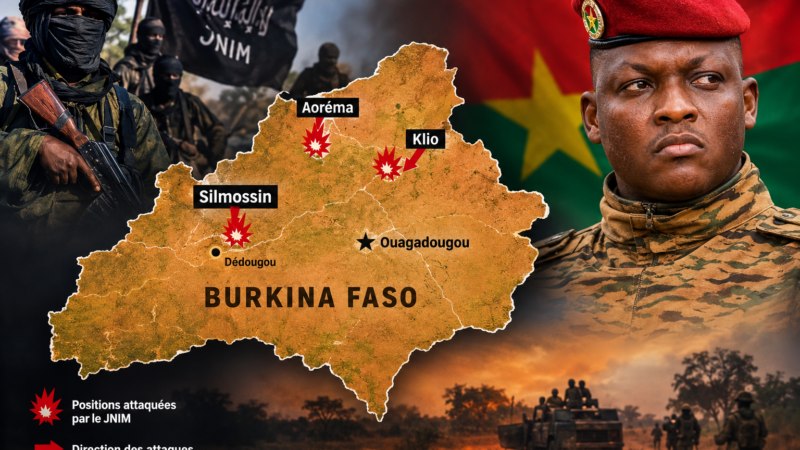
The Group for the Support of Islam and Muslims (Jnim), the dominant jihadist coalition in the Sahel tied to Al-Qaïda, carried out a fresh assault on Sunday, August 9, against a Malian Armed Forces (FAMa) base in the country’s central belt. This strike marks yet another offensive claimed by the jihadist network against government positions, underscoring the ongoing struggle of Mali’s transitional leadership to secure rural expanses.
Another strike against Malian army strongholds
The raid targeted a military outpost in a region that has become a prime battleground for Jnim. Central Mali, especially the vicinities of Mopti and Ségou, has for years been the epicenter of deadly clashes between state forces and jihadist fighters. The coalition led by Iyad Ag Ghali has deepened its foothold here, capitalizing on intercommunal tensions and the erosion of public services in remote areas.
Observers describe a familiar pattern: a synchronized assault on a garrison, an attempt to seize weapons and vehicles, followed by a swift withdrawal before aerial reinforcements can arrive. This asymmetric tactic, executed by nimble motorcycle-mounted units, has become the hallmark of Jnim’s operations across the central Sahel. Casualty figures remain undisclosed, as Malian authorities tightly control narratives surrounding military setbacks.
Jihadist pressure reshaping Mali’s security landscape
The security equation shifted dramatically after the United Nations Multidimensional Integrated Stabilization Mission in Mali (MINUSMA) withdrew at the close of 2023, followed by the departure of French Barkhane forces. Bamako now relies on domestic capabilities, bolstered by the Russian Africa Corps—a structure that replaced the Wagner Group following the death of Yevgeny Prigozhin. Despite these adjustments, militant advances continue unabated, as evidenced by the relentless strikes on military installations.
Under the command of Tuareg leader Iyad Ag Ghali since 2017, Jnim unites several fighting units drawn from Ansar Dine, the Macina Liberation Front, and Al-Mourabitoune. Its ability to launch simultaneous operations in Mali, Burkina Faso, and Niger positions the group as the top threat to the three nations that form the Alliance of Sahel States (AES). Practically, Jnim seeks to encircle regional capitals by imposing roadblocks and enforcing its own system of governance in captured zones.
Transitional authorities face mounting tests
For the transitional government led by General Assimi Goïta, the frequency of these attacks poses both political and military challenges. The regime’s legitimacy hinges on its pledge to reclaim national security. Yet successive reversals—including the July 2024 defeat at Tinzaouatène against a coalition of Permanent Strategic Framework rebels and Jnim fighters—have fueled doubts over the current strategy’s effectiveness.
Regional partners watch developments with growing unease. The Sahel States Confederation, established in July 2024 by Bamako, Ouagadougou, and Niamey, aimed to pool counterterrorism efforts. However, operational coordination remains weak, as each nation grapples with its own immediate crises. Meanwhile, humanitarian access is shrinking in jihadist-held areas, where NGOs struggle to sustain their operations.
The pattern of strikes against fortified camps also raises questions about the FAMa’s perimeter defense doctrine. Concentrating troops in a handful of strongholds—intended to reduce exposure—has ironically turned these sites into high-value targets for an adversary capable of concentrating firepower on identifiable objectives. In the months ahead, Bamako will face mounting pressure to rethink territorial deployment and reclaim abandoned zones.