Japan boosts Cameroon’s economy with $646 million in development aid
Japan’s long-term commitment to Cameroon’s growth

Japan has allocated over $646 million to Cameroon since the Japan International Cooperation Agency (JICA) established its presence in the country in 2006. This significant financial commitment was highlighted during a meeting in Yaoundé between Cameroon’s Minister of Economy, Planning, and Territorial Development, Alamine Ousmane Mey, and JICA Vice-President Ando Naoki. The gathering marked the 20th anniversary of JICA’s operations in Cameroon, alongside the Japan Overseas Cooperation Volunteers (JOCV) program.
Diverse funding mechanisms behind Japan’s support
The $646 million encompasses more than just loans. Japan’s development assistance to Cameroon operates through multiple channels, including grants, concessional loans, and technical cooperation. Grants primarily fund social infrastructure such as schools, classrooms, health centers, and community facilities. Concessional loans, characterized by low interest rates, extended repayment terms, and grace periods, are directed toward large-scale projects in transport and energy sectors. Technical cooperation involves deploying Japanese experts, providing training, conducting feasibility studies, transferring technologies, and sending volunteers to support local development.
Key achievements in infrastructure and capacity building
JICA’s interventions have yielded tangible results across Cameroon. The grants have enabled the construction of over 120 schools and 1,500 classrooms, expanding access to education. Concessional loans have financed critical infrastructure, including the Mintom-Lele road, developed in partnership with the African Development Bank (AfDB). This project strengthens the Yaoundé-Brazzaville trade corridor, enhancing regional connectivity.
The technical cooperation component has had a broad impact, including:
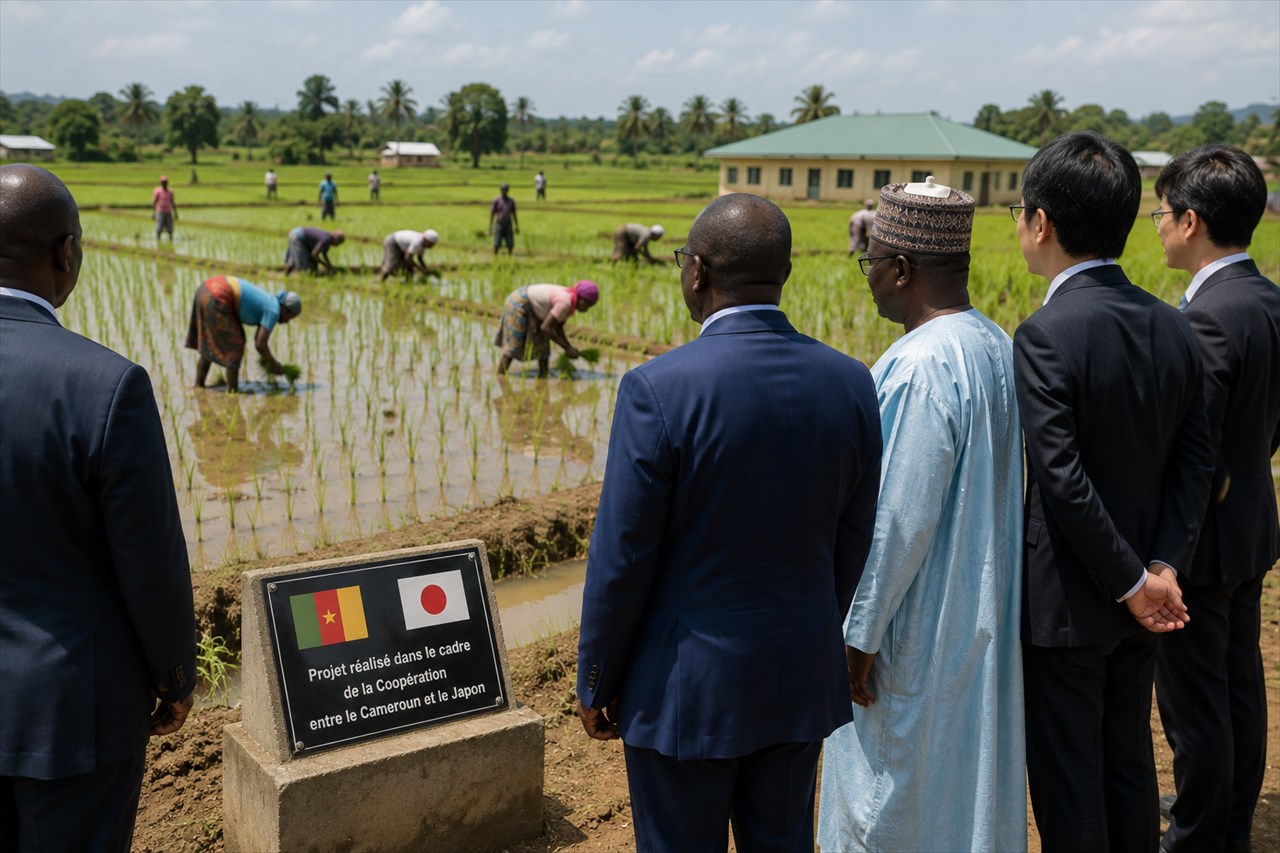
- Training nearly 36,000 rice farmers to boost food security;
- Assisting around 1,500 businesses through the Kaizen methodology, a Japanese approach focused on continuous improvement;
- Empowering thousands of Cameroonians with skills in various sectors.
Future priorities align with national development goals
Discussions between Cameroon’s Ministry of Economy and JICA also explored ways to deepen collaboration in high-priority areas such as agriculture, fisheries, education, infrastructure, environmental sustainability, human capital development, and business competitiveness. These priorities align with Cameroon’s 2030 National Development Strategy (SND30), which aims to drive sustainable growth across key sectors.
In late May 2026, JICA launched a new technical cooperation project focused on restoring savanna and forest landscapes through agroforestry. This initiative reflects Japan’s evolving approach, integrating climate resilience and sustainable resource management into its long-standing focus on infrastructure and capacity building.
Sustainable partnerships for Cameroon’s future
With two decades of engagement in Cameroon, Japan’s development model combines financial aid, technical expertise, and community-driven solutions. As both countries look ahead, the partnership is poised to address emerging challenges while reinforcing Cameroon’s path toward economic and social progress.