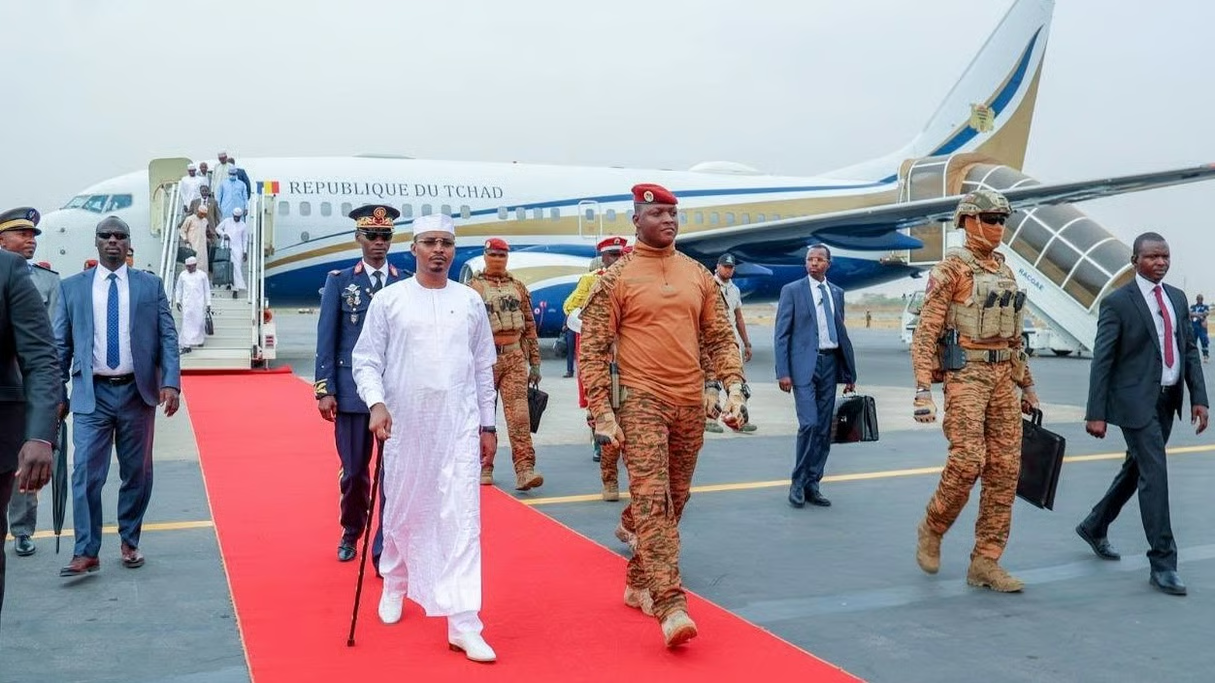
The rise of Mahamat Idriss Déby Itno to power in Chad has sparked intense debate about his political stance, particularly regarding sovereignty. While he presents himself as a defender of national autonomy, critics question the authenticity of his commitment to this principle. His recent engagements with regional actors—especially within the Alliance of Sahel States—have further intensified the discussion.
Chad’s leadership under scrutiny: sovereignty in question
Since assuming leadership after his father’s tenure, Mahamat Idriss Déby Itno has positioned himself as a pan-Sahelian leader, advocating for greater regional self-reliance. Yet, the extent of his sovereignist rhetoric remains a subject of sharp divide. His administration has pursued policies that both align with and challenge traditional alliances, leaving observers to ponder: does he truly champion Chadian independence, or does he merely instrumentalize sovereignty for political leverage?
Key decisions—such as the reassessment of security partnerships and economic agreements—have been framed as moves toward self-determination. However, some analysts argue that these steps reflect strategic realignments rather than a genuine break from foreign influence. The delicate balance between asserting autonomy and maintaining international cooperation continues to define his governance.
Regional alliances and their impact on Chadian sovereignty
The formation of the Alliance of Sahel States has been a defining moment for regional politics. Chad’s participation under Mahamat Déby’s leadership has been both praised as a bold step toward regional unity and criticized as a potential dilution of national sovereignty. The alliance, which includes Mali and Burkina Faso, promotes collective security and economic cooperation—but at what cost to individual member states’ independence?
Critics point to the bloc’s reliance on external partners, including the United Arab Emirates, whose involvement raises concerns about new forms of dependency. Meanwhile, Mahamat Déby has sought to portray the alliance as a third-way alternative, free from former colonial powers. Yet, the reality remains complex, with questions lingering over the true extent of Chadian autonomy within this framework.
International relations: balancing sovereignty and pragmatism
Chad’s foreign policy under Déby has oscillated between assertive regionalism and cautious diplomacy. His government has engaged with global powers like France, while simultaneously seeking to reduce reliance on traditional allies. This dual approach has drawn both support and skepticism. Some view it as a necessary adaptation to shifting geopolitical realities, while others see it as a calculated strategy to maintain power while appearing sovereign.
The Emirati presence in Chad’s economic and military sectors has further complicated the sovereignty debate. While some agreements have brought much-needed investment, others have fueled accusations of neo-colonial interference. Déby’s government has defended these partnerships as mutually beneficial, but the lack of transparency in many deals has only deepened mistrust among citizens and observers alike.
Public perception and the future of Chadian sovereignty
The question of Mahamat Idriss Déby Itno’s sovereignist credentials resonates deeply across Chadian society. Supporters highlight his efforts to diversify partnerships and reduce dependence on former colonial powers, framing him as a leader who prioritizes national interests. Detractors, however, argue that his actions often serve elite interests while failing to translate into tangible benefits for ordinary citizens.
As Chad navigates an era of profound change, the debate over sovereignty will likely intensify. Will Déby’s leadership usher in a new era of true independence, or will it merely recalibrate the terms of external influence? The answers may well shape the country’s trajectory for years to come.