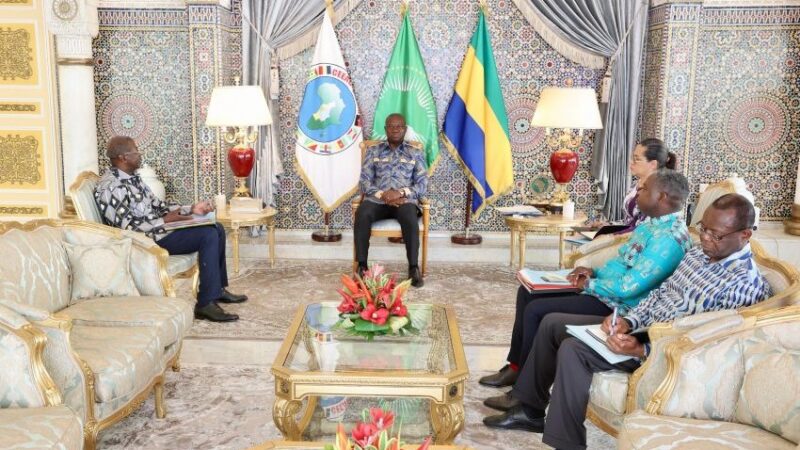
Gabon’s CNR challenges Oligui Nguema’s transition leadership
The National Republican Coalition (CNR) has launched a bold political offensive against Gabon’s transitional leadership. In a rare public statement, the coalition directly targets President Brice Clotaire Oligui Nguema, accusing him of inconsistent decision-making and betraying the foundational principles of the post-coup institutional shift that followed Ali Bongo Ondimba’s fall from power. This unusually sharp critique signals a significant shift in Gabon’s political landscape.
Direct criticism of transitional governance
The CNR condemns what it describes as a pattern of missteps in the management of public affairs under Oligui Nguema’s leadership. The coalition argues that the transitional government has demonstrated an inability to maintain a consistent policy direction, frequently reversing decisions and struggling to establish a coherent economic and institutional roadmap. These repeated inconsistencies, according to the coalition, are fostering a climate of uncertainty detrimental to both domestic economic actors and international partners.
The CNR’s rhetoric is uncompromising. The coalition uses the term approximations to describe what it sees as a lack of preparation and expertise in public policy formulation. This critique goes beyond partisan politics, raising fundamental questions about the capacity of the regime that emerged on August 30, 2023, to translate its initial momentum into a robust governance framework capable of withstanding upcoming challenges.
An opposition rising amid growing scrutiny
Since the military takeover, Gabon has been navigating a transition timeline that has undergone multiple revisions. The constitutional referendum, the adoption of a new electoral code, and the April 2025 presidential election—won by Oligui Nguema—have created a path that his supporters frame as an orderly return to constitutional life. Critics, however, interpret this trajectory as a consolidation of personal power.
It is on this very issue that the CNR seeks to stake its claim. By highlighting the inconsistencies in the current governance, the coalition aims to carve out a structured opposition space, which remains relatively vacant in the country. This move unfolds against a backdrop where several political figures, particularly those from the former Bongo establishment or civil society, are reassessing their positions in response to an executive that has dominated the public agenda for the past two years.
The coalition’s grievances extend to both methodology and substance. Methodologically, it condemns a lack of consultation with intermediary bodies and political forces. Substantively, it questions the coherence of economic announcements, the clarity of reforms, and the government’s ability to fulfill the promises of systemic change made during the early months of the transition.
International implications of domestic criticism
Beyond domestic politics, the CNR’s statement carries weight that extends beyond Gabon’s borders. Libreville remains under close observation by African partners, the Economic Community of Central African States (ECCAS), and international donors, all keenly interested in the country’s institutional stability. Any structured opposition to Oligui Nguema’s chosen path influences evaluations conducted in Brazzaville, Addis Ababa, or Paris.
The challenge for the coalition now lies in translating its vocal opposition into tangible political momentum. Upcoming local and legislative elections will serve as a critical test. These contests will reveal whether the criticisms resonate with an electorate still awaiting tangible improvements in daily life—higher purchasing power, better access to public services, and stronger anti-corruption measures.
For Gabon’s transitional leadership, the stakes are twofold. First, it must address the substance of the criticisms to preserve the credibility of public discourse. Second, it must prevent the fragmented political opposition from consolidating into a unified force capable of uniting beyond its original circles. This latest salvo from the CNR marks a turning point in Gabon’s post-transition political debate.