Gabon’s boulevard of transition faces financial scrutiny
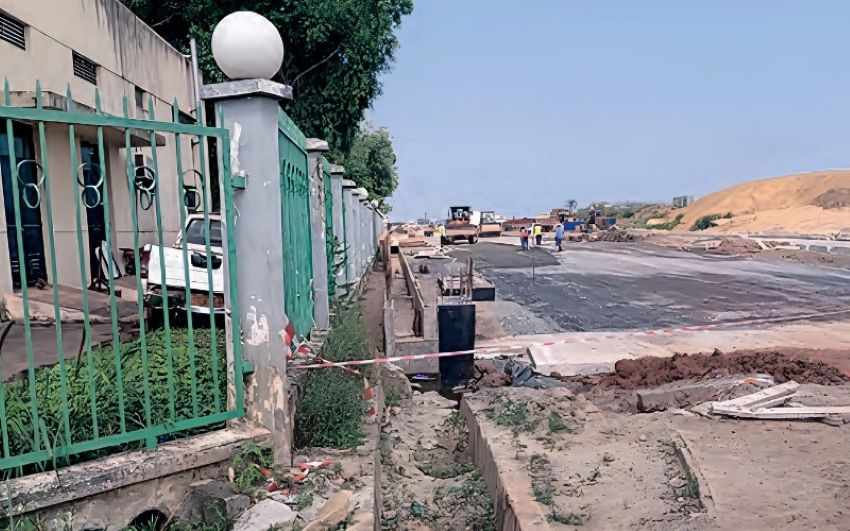
Libreville, August 26, 2026 — Libreville’s Boulevard de la Transition is advancing on two critical fronts. On-site, construction crews are racing against time to meet deadlines and deliver key sections. Meanwhile, behind closed doors, authorities are grappling with a far more delicate challenge: ensuring complete transparency in public spending.
Recent technical and financial reviews of the project have raised significant concerns. The initial contract value reportedly ballooned from 8 billion to 16 billion CFA francs, while approximately 3 billion francs were disbursed to an overseas operator identified only as Goran. These findings, still under judicial review, have thrust the project into the spotlight as a test case for public procurement integrity.
The Boulevard de la Transition is no ordinary roadworks project. Stretching nearly three kilometers, this flagship initiative is designed to ease traffic congestion in Gabon’s capital while serving as a cornerstone of a broader urban modernization plan. Its completion is a stated government priority for 2026.
What was meant to showcase visible progress now faces scrutiny over its financial underpinnings. How could a public contract double in value? What procedures permitted payments now under question? These are the questions demanding answers as investigations unfold.
Financial irregularities under judicial review
Auditors examining the project’s finances have uncovered troubling details. According to official findings, 3 billion francs were transferred to Goran without prior bank guarantees. The operator was later questioned and, according to reports, admitted to “serious errors” before leaving the country. The case has since been forwarded to prosecutorial authorities.
Caution is warranted at this stage. No definitive conclusions can be drawn about potential wrongdoing or individual liability until full investigations conclude. The judiciary’s role is to clarify financial flows, validate contractual procedures, and determine whether any laws were violated.
The broader implications extend beyond Goran’s case. They strike at the heart of how public contracts are awarded, executed, and audited in Gabon. If the allegations hold, why were no bank guarantees required? If the contract value doubled, what contractual amendments and administrative approvals were involved? These are not minor administrative questions—they go to the core of governance.
The Boulevard de la Transition must not become a symbol of completed infrastructure overshadowing financial accountability. Citizens expect more than asphalt and concrete. They demand verifiable, justifiable public spending.
Balancing urgency with accountability
While financial inquiries continue, construction teams are under pressure to accelerate work. A recent report dated August 22 calls for expedited material deliveries, expanded equipment deployment, and night-shift operations. Presidential directives have set a September 1 deadline for completing the PK0+240 to PK0+800 section, prioritizing urban mobility benefits.
Such urgency is understandable. Yet it must not come at the expense of proper documentation and evidence preservation. Every contract, payment, and procedural decision must be traceable. The government’s commitment to transparency is being tested not just in courtrooms, but on the ground where concrete meets pavement.
This dual-track approach—progress and probity—is non-negotiable. Past urban projects in Libreville have left a legacy of financial and social consequences. In 2025, the Council of Ministers approved waste management plans for demolition debris from the Boulevard’s construction. Relocation support for affected families received backing from the BDEAC, underscoring the human dimension of such initiatives.
The Boulevard de la Transition will be judged by two yardsticks: kilometers paved and francs accounted for. Success in one without the other is no success at all.
If irregularities are confirmed, those responsible must be held to account, and any losses recovered. If they are not, the truth must be established just as clearly. Either way, the project’s true legacy will hinge on whether Gabon’s public finances are finally made fully transparent, from the first signature to the last franc spent.