Fifteen GARSI soldiers killed at Abala-Filingué: a direct hit on Niger’s security promises
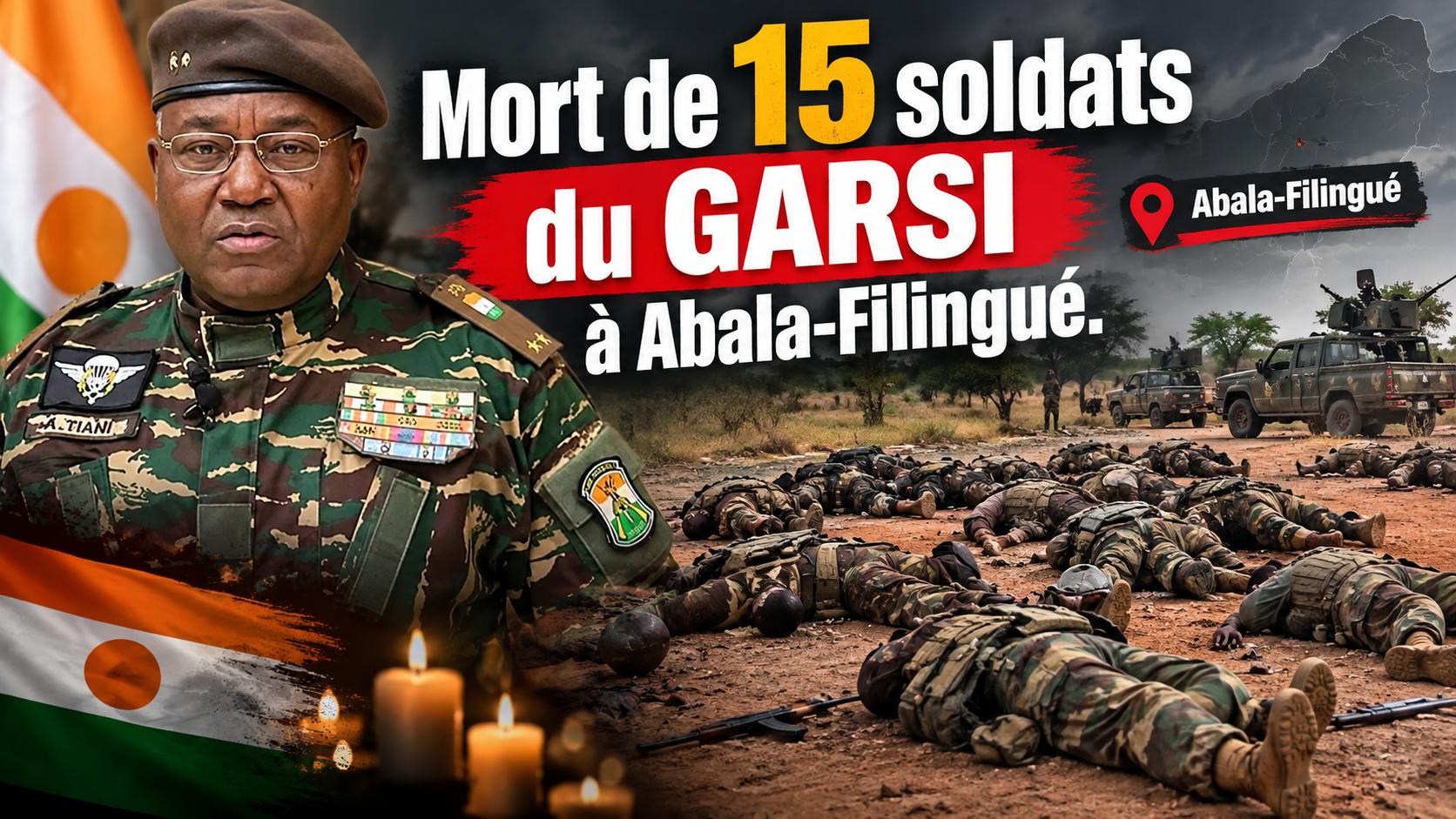
The attack that hit the Abala-Filingué department this morning has landed another crushing blow on Niger. A patrol of the Rapid Action Surveillance and Intervention Group (GARSI) came under fire in an assault of extreme violence, and the provisional toll is heavy: around fifteen soldiers killed on the spot, among them Captain Hassoumie and Warrant Officer Djindagarey. For the country’s elite units, this is far more than a single bad day. It stands as the starkest illustration of a nation drifting deeper into chaos since General Abdourahamane Tiani took power by force.
The gap between Niamey’s narrative and the battlefield
When the National Council for the Safeguard of the Homeland (CNSP) removed elected president Mohamed Bazoum from office on 26 July 2023, it presented the restoration of security as the very reason for its takeover. The junta pledged swift, decapitating strikes against jihadist groups and justified its coup with claims of a collapsing security front.
The deaths of Captain Hassoumie, Warrant Officer Djindagarey and the troops who fell beside them expose how wide the distance has grown between official messaging in Niamey and conditions on the ground. Far from containing the threat, the military leadership has disrupted the armed forces, weakened the chain of command and sent seasoned troops into combat without adequate tactical or air cover.
Violence by the numbers since the July 2023 coup
Triumphalist speeches from the transitional authorities paint a very different picture from the data compiled by independent conflict monitors. The record for Niger under Tiani’s rule is sobering:
- More than 1,500 incidents of political violence recorded nationwide since the July 2023 coup.
- Over 5,800 dead, civilians and soldiers combined, across the same period.
- A rise of more than 40% in civilian casualties from direct attacks during the first months after the takeover, compared with the preceding period.
- Record military losses: lethal ambushes such as Koutougou (17 dead) and Tabatol (29 dead), along with repeated tragedies in the Tillabéri and Tahoua regions, underline the persistent vulnerability of the defence and security forces.
Even elite units are no longer safe
In the vast three-border zone where the Group for the Support of Islam and Muslims (GSIM) and the Islamic State in the Greater Sahara (EIGS) operate, the state has been losing ground. The strike at Abala-Filingué confirms that armed groups can now hit hardened units such as GARSI with complete impunity.
Scrapped defence deals and a shrinking toolbox
How could a regime led by senior officers allow security to deteriorate this far? The failure rests on a string of dogmatic and questionable strategic choices. By unilaterally tearing up defence agreements with Niger’s traditional partners, notably France and the United States, the Tiani government stripped its army of essential assets: high-precision intelligence, long-range drone surveillance and fast medical evacuation capacity.
To fill the void, Niamey rushed into the Alliance of Sahel States (AES) with Mali and Burkina Faso and turned to new allies, Russia among them. On the ground at Abala-Filingué, as elsewhere in Tillabéri, that realignment has changed almost nothing. Reconnaissance drones cannot compensate for a lack of tactical anticipation, and infantry units keep paying a very heavy price against mobile, well-armed assailants.
Meanwhile, the junta channels its energy into political survival — pursuing opponents, restricting press freedoms and organising shows of support — while the safety of soldiers and ordinary people slips down the list of priorities.
The ordeal of civilian communities
If the loss of elite officers grieves the army, civilians are the first to suffer from the state’s retreat. In the Tillabéri region, terror has become the rule. Armed groups impose the zakat on residents, burn schools, loot markets and execute anyone who refuses to submit.
The security crisis drags a major humanitarian disaster in its wake:
- More than 450,000 people are now internally displaced in Niger, having fled their villages as jihadist pressure grows.
- Around 3.3 million people face acute food insecurity, worsened by closed trade routes and abandoned farmland.
- Hundreds of schools have shut down, depriving tens of thousands of children of their future.
A reality the junta can no longer dodge
The deadly strike on GARSI at Abala-Filingué can no longer be smothered under sovereignist slogans or pinned on outside scapegoats. It lays bare General Tiani’s inability to keep the fundamental promise that served as the pretext for his coup: protecting Nigeriens and guaranteeing the country’s territorial integrity.
By losing Captain Hassoumie, Warrant Officer Djindagarey and the soldiers who died with them, the military government reveals the limits of its approach. The junta urgently needs to step out of denial, reassess its defence strategy and accept a simple truth: the legitimacy of a government is not measured by control of the capital, but by its ability to keep soldiers alive at the front and citizens safe in their villages. Without a radical rethink, Niger risks sinking even deeper into the abyss.