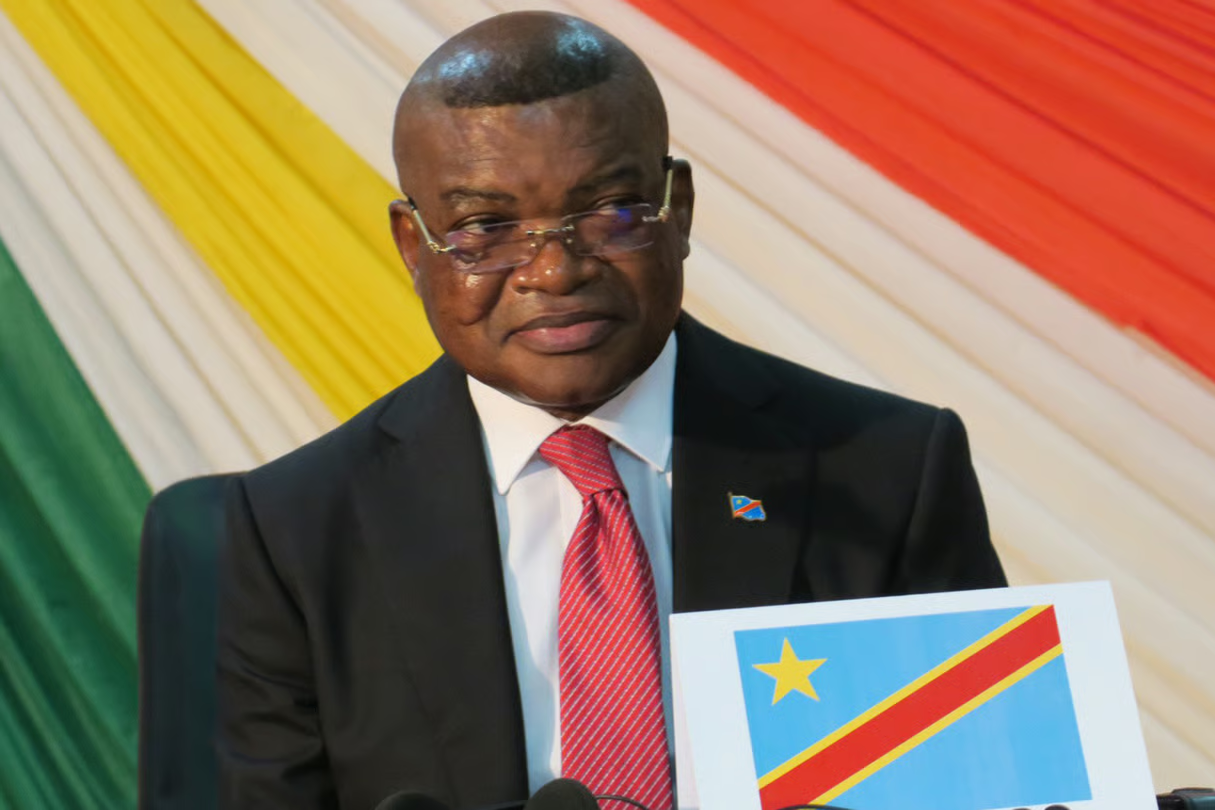
Behind the headline news of Kalev Mutond’s death lies a more complex story about how power, secrecy, and institutional weakness intertwine in the Democratic Republic of Congo. As the former head of the country’s intelligence services, Mutond’s passing is not merely an obituary — it is a lens through which the fault lines of Congo’s security apparatus become visible. Understanding the dynamics at play requires looking beyond the immediate announcement to the structural realities that shaped his career and continue to shape the nation’s intelligence community.
The man who knew too much: Mutond’s role in Congo’s shadow networks
Kalev Mutond served as the general administrator of Congo’s intelligence agency, a position that placed him at the intersection of political power and covert operations. During his tenure, he was widely regarded as one of the most influential figures in the country’s security architecture — a gatekeeper of secrets and a strategist whose reach extended into the highest echelons of government. His career was closely tied to the presidency of Joseph Kabila, under whom he consolidated significant authority.
Yet the very nature of his role meant that much of his work remained invisible to the public eye. Intelligence chiefs operate in a realm where information is currency and discretion is survival. Mutond’s longevity in such a position suggests a rare ability to navigate the treacherous currents of Congolese politics — a skill that also made him a polarizing figure.
Structural weaknesses beneath the surface
The death of a figure like Mutond inevitably raises questions about the broader health of the institutions he once led. Congo’s intelligence services have long been criticized for opacity, politicization, and a lack of accountability. These are not merely administrative flaws; they are symptoms of deeper governance challenges that have persisted across multiple administrations.
When an intelligence apparatus becomes synonymous with the individuals who lead it, its institutional resilience is called into question. Mutond’s passing thus serves as a reminder that personal networks and informal power structures often fill the gaps left by weak formal institutions. This dynamic is not unique to Congo, but its consequences are particularly acute in a country of vast size and complex security pressures.
What the silence tells us
In the aftermath of Mutond’s death, the relative quiet from official channels is itself telling. In many democracies, the passing of a former intelligence chief would prompt a measured public acknowledgment and perhaps a reflection on the agency’s evolution. In Congo, the response has been more muted — a pattern that underscores the ongoing sensitivity surrounding the intelligence services and their historical entanglement with political power.
This silence also highlights the difficulty of separating fact from speculation in matters of national security. Without transparent mechanisms for oversight, narratives about figures like Mutond are shaped as much by rumor and recollection as by documented record. That ambiguity is part of the legacy he leaves behind.
The road ahead for Congo’s intelligence community
Kalev Mutond’s death does not mark the end of an era so much as it exposes the unresolved questions of that era. The future of Congo’s intelligence services depends on whether the country can move toward greater professionalism, clearer legal frameworks, and genuine civilian oversight. These are long-term projects that require political will and sustained institutional investment.
For now, the passing of a man who once stood at the center of Congo’s covert world serves as a case study in how personal power and state security can become dangerously intertwined. The lessons are not just for Congo but for any nation grappling with the challenge of building intelligence institutions that serve the public interest rather than private agendas.