Molodo ambush: Africa Corps rout leaves Mali’s junta without a Russian alibi
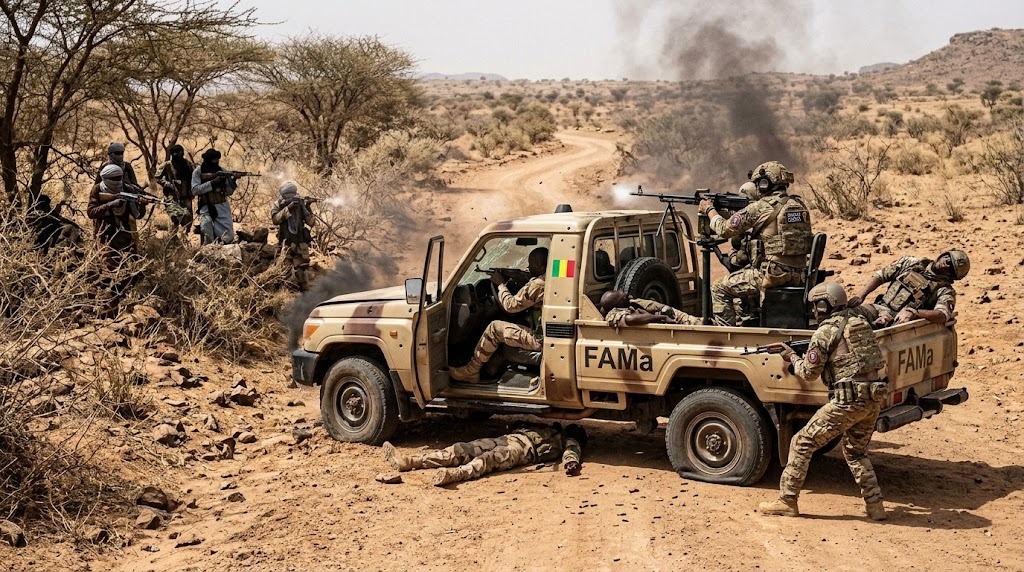
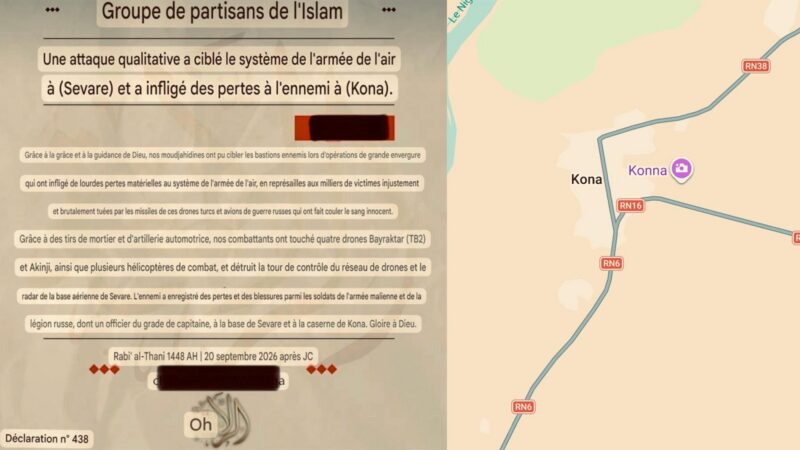
The firefight lasted minutes. What it left behind on the roadside will take far longer to explain away. On 20 September 2026, on the dirt track running from Diabali to Niono, a mixed patrol of Malian armed forces (FAMa) and Russian paramilitaries from Africa Corps drove straight into an ambush laid by the Group for the Support of Islam and Muslims (JNIM), Al-Qaeda’s Sahel branch. The Russian contingent answered with the reflex that has become its trademark: a swift withdrawal that left three all-terrain vehicles on the shoulder of the road, exposed to the attackers’ lenses, each still carrying the stylised triangle that identifies Africa Corps.
The ambush on the Diabali–Niono track
Molodo lies in the Ségou region, territory the authorities in Bamako describe as securely held. Yet a joint column moving through it was broken apart within minutes, and nothing arrived in time to reverse the outcome. The patrol’s destruction, and above all the manner of it, contradicts the version of the war Mali’s military leadership has been selling for four years.
Africa Corps, the rebranded Wagner formation placed under the direct supervision of Russia’s defence ministry, surrendered its position, its equipment and whatever remained of its aura. What the retreat cost in casualties is unclear; what it cost in credibility is not.
Three vehicles left behind and what they reveal
Abandoned on the verge of the road, photographed from every angle by the fighters who had just routed them, the vehicles bear the insignia of a force that is supposed to be turning the tide. For the junta of Colonel Assimi Goïta, Molodo is not simply one more tactical setback in a war of attrition it does not control. It is a magnifying mirror held up to a political and security failure whose scale can no longer be disputed.
Four years of the Russian gamble
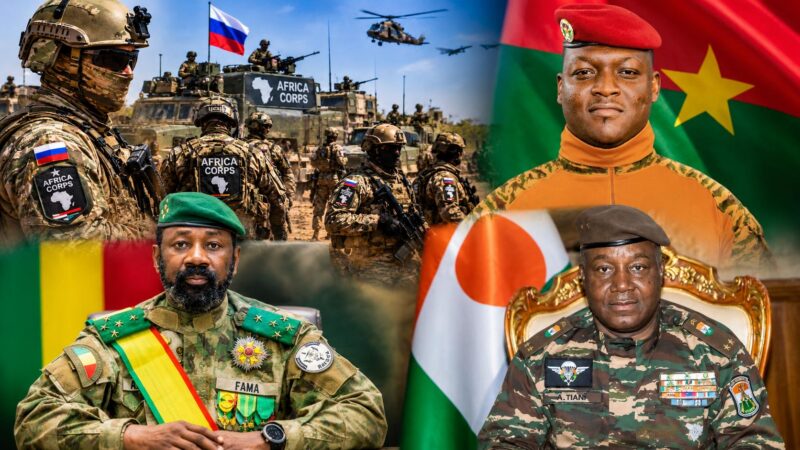
After expelling French forces deployed under Operation Barkhane, pushing the UN mission MINUSMA towards the exit and tearing up the peace agreements, the military leadership staked its entire legitimacy on a single promise: the recovery of national sovereignty and the full securing of the territory through a geopolitical break with the West. To persuade a population worn down by more than a decade of instability, Bamako marketed Russian diplomacy as the miracle cure, insisting that Moscow’s instructors would achieve what Western allies had neither the will nor the capacity to deliver.
What the partnership has actually produced
Four years after the first mercenaries landed on Malian soil, the verdict is blunt. The Russian partnership is a costly illusion. Far from eradicating the jihadist threat, the arrival of the Russian militia turned into a powerful recruitment engine for armed opposition and Islamist groups.
Insecurity as the machinery of rule
Propaganda can no longer bury the facts. Despite triumphant communiqués drafted from the air-conditioned offices of the general staff in Bamako, Mali has rarely been in worse shape. Violence once confined to the desert fringes of the north has spread through the centre of the country, and it now presses in on the capital itself:
- economic strangulation of supply routes and markets
- road blockades that isolate entire districts
- repeated attacks on military garrisons
The men paid to protect a regime, not a country
Molodo lays bare a brutal military truth: Africa Corps fighters are neither invincible nor attached to the cause of the Malian people. Paid handsomely by a state running on empty, one that drains its thin public resources and hands mining concessions to companies tied to the Kremlin, they operate as a close protection force for the government rather than a liberation army. In the field, facing a mobile enemy perfectly acclimatised to the terrain, blind brutality has replaced tactical thinking. Joint FAMa-Russian operations, dogged by repeated accusations of abuses and killings of civilians, have finished the job of severing the army from rural communities.
Doubt treated as betrayal
To muzzle dissent in the face of this continuous security and economic deterioration, the junta has rolled out an unprecedented repressive apparatus. Critical voices from civil society are muted, the independent press is censored or hunted down, and the slightest question about the effectiveness of the Russian partner is immediately branded high treason or collusion with the enemy.
Photographs that travel faster than propaganda
Propaganda, however, offers no protection against the reality on the ground. Images of the three vehicles stamped with the Africa Corps logo, deserted by their Russian crews on the Molodo road, are already circulating quietly and on social media. They give visual form to what many Malians now say only in whispers: in the name of fighting neocolonialism, the military leadership traded an imperfect dependency for a ruinous submission to a private militia that cannot guarantee peace.
An impasse with no exit in sight
By persisting in this ideological and military flight forward, Bamako’s rulers have locked Mali into a tragic dead end. Without a comprehensive political strategy, without national reconciliation, and with foreign troops who run at the first shot, the Malian state keeps dissolving, leaving a battered population to the extremists and the war profiteers.