
Geopolitical tensions between Morocco and Spain often dominate headlines, but beneath disputes over Ceuta, Melilla, and migration flows lies a far less visible yet critical factor: energy dependence. While Rabat asserts its territorial claims and security priorities, its energy security remains inextricably linked to Spanish infrastructure.
Despite periodic challenges to Spanish sovereignty claims, Morocco continues to rely heavily on Spanish-controlled energy networks for both gas and electricity supplies. This creates a paradoxical dynamic where Rabat’s strategic ambitions are constrained by its own energy vulnerabilities.
Gas pipelines reveal hidden dependencies
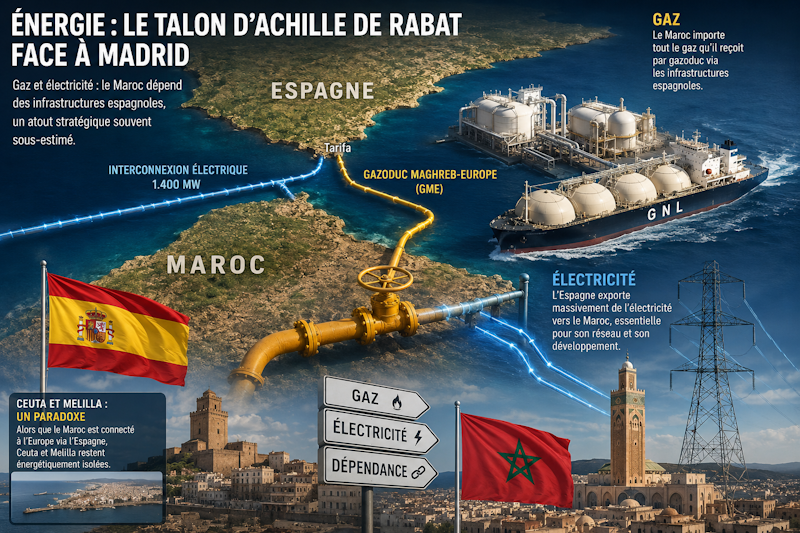
The rupture in Morocco-Algeria relations in 2021 transformed the energy landscape between Morocco and Spain. With the Maghreb-Europe Gas Pipeline (GME) no longer carrying Algerian gas to Europe via Morocco, the flow direction reversed. Spain began supplying gas to Morocco through the same infrastructure that once transported Algerian gas.
Official figures indicate Morocco received approximately 10.3 terawatt-hours of gas in 2025, valued at nearly €400 million—equivalent to about a quarter of Spain’s total gas exports that year. This reversal highlights how Morocco’s energy security now depends on Spanish infrastructure it once used solely for transit.
Rabat’s strategic response
Moroccan authorities are actively working to reduce this vulnerability through several major energy projects. The Nador West Med LNG terminal represents a key initiative to establish direct gas import capacity via maritime routes, allowing Morocco to bypass Spanish pipelines. Another ambitious project, the Nigeria-Morocco gas pipeline, aims to connect West African gas reserves to Moroccan and European markets.
These long-term solutions require substantial investment and time. In the interim, Spain maintains a pivotal position as Morocco’s primary gas supplier through pipeline infrastructure. The energy relationship thus becomes a subtle yet powerful element in their bilateral balance.
Electricity interconnections strengthen Spain’s leverage
The energy interdependence extends beyond gas. Two submarine cables currently connect the Spanish and Moroccan electricity grids, with a combined capacity of 1,400 megawatts.
In 2025, Spain exported 3,743 gigawatt-hours of electricity to Morocco—a 47.5% increase from the previous year and the highest level since 2017. Nearly three-quarters of this capacity flows from Spain to Morocco, demonstrating the asymmetric nature of the relationship.
These connections provide Morocco with crucial grid stability and additional capacity as the country expands its renewable energy infrastructure and industrial base. The two nations are also planning a third submarine cable to further enhance interconnection capabilities.
Ceuta and Melilla: an energy paradox
The Morocco-Spain energy relationship presents a striking contrast in how territories are connected. While Morocco benefits from direct integration into the European electricity grid via Spain, the Spanish cities of Ceuta and Melilla have historically operated as energy islands.
Ceuta will soon end its isolation with a new submarine cable connecting it to mainland Spain, representing an investment of approximately €300 million to enhance energy security. Melilla, however, will remain disconnected due to geographical constraints.
This disparity underscores how energy interdependence creates unexpected power dynamics—Morocco enjoys European grid integration, while parts of Spain remain reliant on autonomous systems.
Energy as a silent geopolitical lever
The strategic importance of these energy networks becomes particularly apparent amid rising Mediterranean tensions. While neither country may weaponize energy supplies, the structural vulnerability creates potential diplomatic pressure points.
Historically, Morocco has held advantages in migration control and security cooperation. However, energy dependence introduces a new dimension where Spain gains strategic influence through critical infrastructure.
The Morocco-Spain relationship remains complex, with Rabat pursuing ambitious energy diversification projects. Yet these solutions remain years away from operational capacity. Until then, Spain’s control over gas pipelines and electricity interconnections represents a subtle but significant counterbalance to Morocco’s regional ambitions.