Burkina Faso’s locally built armored vehicles face real-world test after insurgent gains
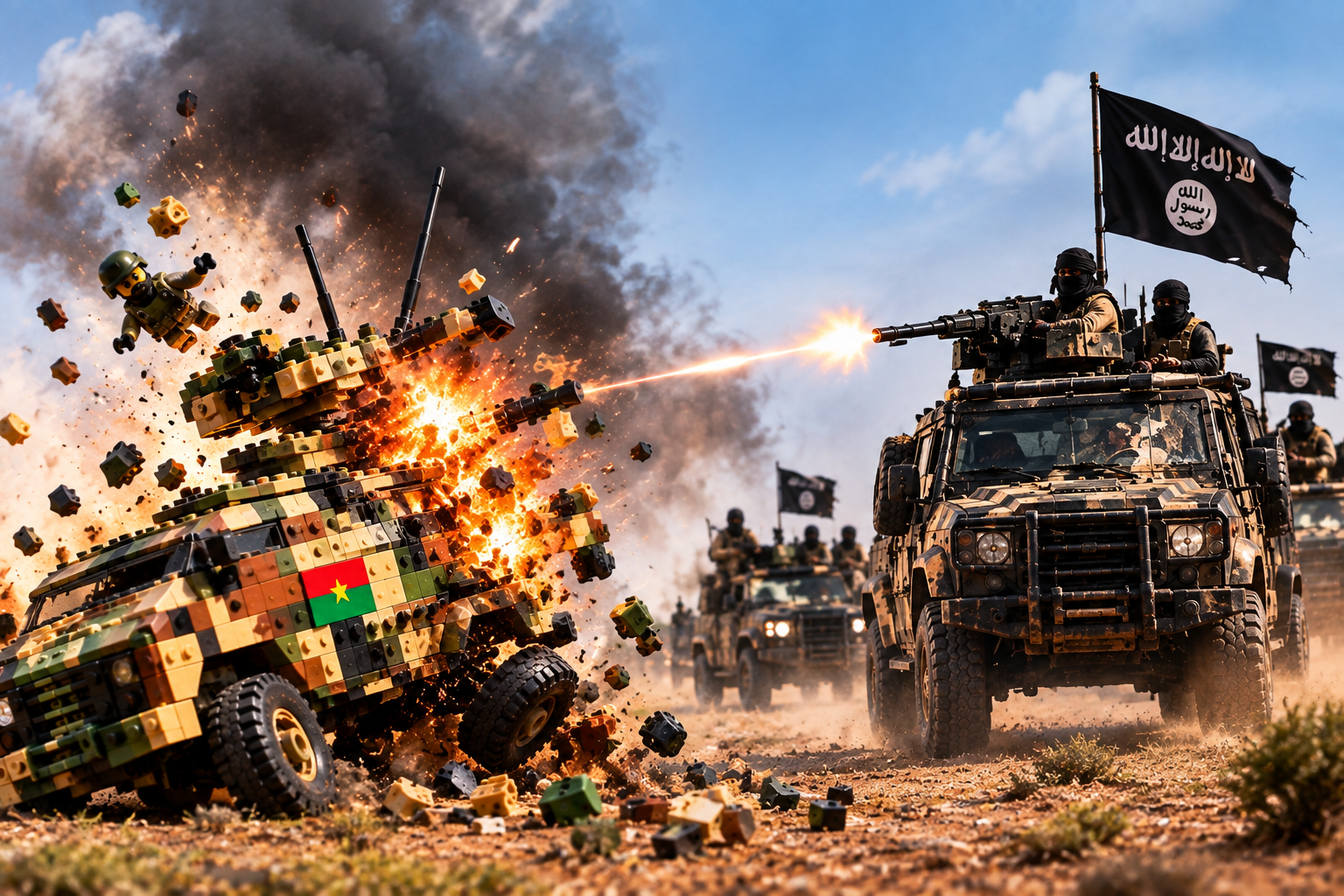
When propaganda meets battlefield reality in Burkina Faso
Mahlou and Winten have become the latest proving ground where Burkina Faso’s military hardware ambitions collide with the harsh truths of the Sahel’s insurgency.
On September 16, 2026, the Group for the Support of Islam and Muslims (JNIM) claimed control of two strategic positions held by the Volunteers for the Defense of the Homeland (VDP) in Bam Province. While independent verification remains pending, the insurgent group’s announcement alone has sparked intense scrutiny of Burkina Faso’s indigenous armored vehicle initiative.
The incident arrives at a critical juncture for a government that has staked much on its self-proclaimed military industrial revolution. Official narratives have repeatedly touted domestic manufacturing as the cornerstone of Burkina Faso’s quest for military autonomy and counterinsurgency resilience. Yet, as armored vehicles once paraded as breakthroughs in local innovation face the unforgiving conditions of the battlefield, fundamental questions about their efficacy are now impossible to ignore.
Is Burkina Faso’s ‘industrial miracle’ on wheels truly the game-changer it has been advertised to be? Or are these vehicles, in the words of critics, little more than hastily assembled contraptions unable to withstand the realities of asymmetric warfare?
From assembly lines to front lines: a high-stakes transition
The fall of Mahlou and Winten, if confirmed, would mark the second major insurgent victory in less than a month in Bam Province. Earlier in August, JNIM forces had overrun positions in Séguénéga and Bourzanga, raising serious doubts about the durability of recent counteroffensives. The recurring pattern of territorial reversals suggests that Burkina Faso’s military renaissance may be struggling to translate industrial ambition into battlefield dominance.
While government officials emphasize the symbolic importance of local manufacturing highlighting reduced dependency on foreign aid and enhanced national pride the practical challenges are now impossible to downplay. The VDP, a civilian defense force at the heart of the counterinsurgency strategy, has increasingly relied on these armored vehicles to secure rural areas. But when positions fall despite their presence, the narrative of technological empowerment begins to unravel.
The armored vehicles, often showcased in highly staged presentations, now face a moment of truth. Can they survive sustained attacks? Do they provide meaningful protection to occupants under prolonged fire? Most critically, can they help stabilize regions that have seen repeated cycles of conquest and loss?
For years, Burkina Faso has championed its shift from importer to producer of military equipment. Yet the unfolding events in Bam Province force a reckoning: industrial pride alone cannot secure territory. Performance under pressure is what defines a military asset not the headlines it generates.
Sovereignty sells but does it hold?
The government’s emphasis on indigenous production reflects a broader geopolitical strategy aimed at reducing reliance on traditional allies and fostering self-sufficiency. Since 2023, state-backed initiatives have accelerated the assembly and partial manufacturing of armored vehicles, with officials insisting these platforms represent a sustainable path forward. The narrative has resonated with nationalists and citizens weary of foreign aid strings and delayed deliveries.
But national pride, while powerful in speeches, is no substitute for battlefield results. The fall of Mahlou and Winten whether partial or complete would force a difficult conversation about where the real challenges lie. Are the vehicles insufficiently armored? Are supply chains compromised? Do training levels among VDP units undermine the utility of these assets?
Analysts point to a growing disconnect between the pace of industrial development and the immediate demands of counterinsurgency. While prototypes and prototypes are celebrated, sustaining operations under fire requires more than structural integrity it requires integration into a broader tactical framework.
The insurgents, in contrast, operate with agility, exploiting terrain and using guerrilla tactics that render static defenses vulnerable. When JNIM claims new positions, it does so not because it has superior firepower, but because it has exploited weaknesses in defense and logistics. If armored vehicles are tied down in unsuitable positions or lack the mobility to respond to attacks, their presence may actually create more targets without delivering real security.
What happens next? The stakes for Burkina Faso’s military trajectory
The coming weeks will determine whether Burkina Faso’s armored vehicles will be remembered as a triumph of innovation or a cautionary tale of overpromising and under-delivering. If the claims about Mahlou and Winten are substantiated, pressure will mount for a transparent review of procurement standards, operational doctrines, and performance metrics.
Public debate is already intensifying. Accusations of incompetence, cronyism in defense contracting, and a rushed industrialization drive are gaining traction. Civil society groups and opposition voices are demanding accountability, questioning whether national pride has blinded leaders to operational realities.
For the government, the path forward is fraught. Doubling down on these vehicles could deepen public distrust if they continue to fail. Scaling back the initiative risks undermining a core pillar of its legitimacy. The only viable option may be to acknowledge that industrial ambition must be matched by sustained testing, rigorous evaluation, and adaptive strategy on the ground.
The people of Bam Province caught in the crossfire of a conflict where both sides now turn their attention to armored capabilities deserve more than rhetoric. They deserve security that endures beyond the headlines. And Burkina Faso’s armored vehicles, whatever their design, will be measured not by how they look in propaganda videos, but by how they perform when the bullets start flying.